
Besides the Pristophone, I have one other extant homemade instrument. The nail violin is a project from the summer of 2009, constructed in the Humanities Building in the middle of my time at UW-Madison.
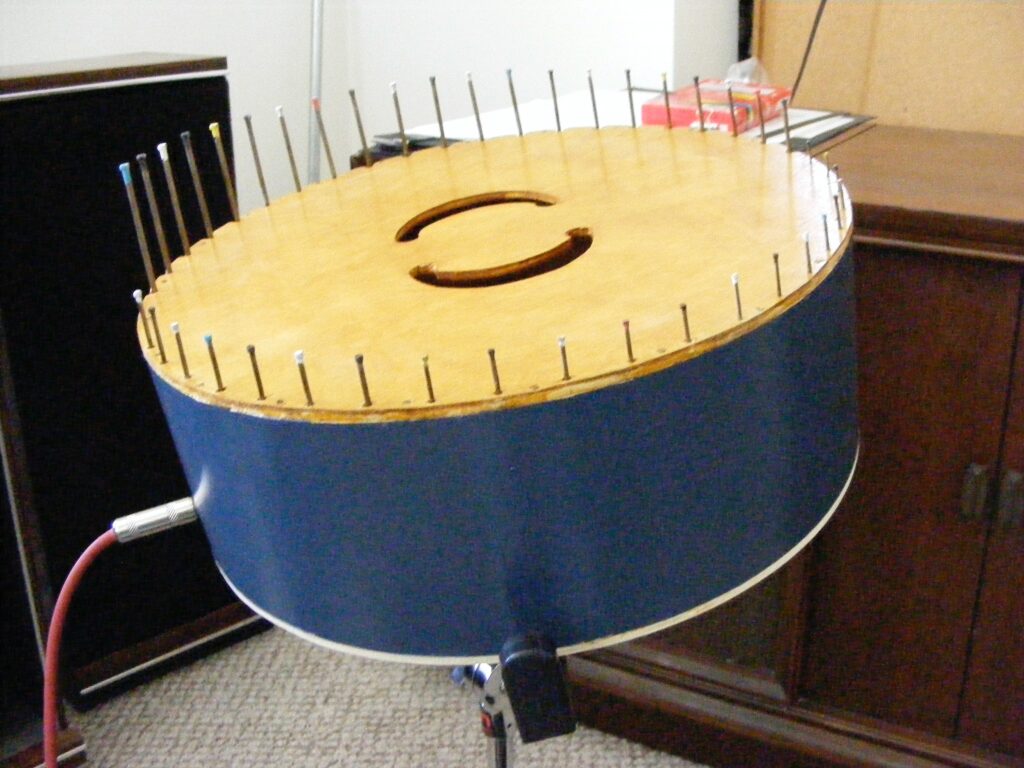
I knew of the concept of a nail violin at the time, but there was very little practical information available online, except for a photo of an early version and a brief biography of the inventor, Johann Wilde. I had also seen the instrument mentioned in a recording I came across on UbuWeb, Mauricio Kagel’s ACUSTICA (1971), describing the particular instrument as “a form of the idiophonic friction-instrument invented in the mid-18th century, with 16 iron rods of equal width but of different lengths (between 2 1/25 and 16 4/5″; temperature 15√8) which vibrate transversally when played with a cello or double-bass bow.”
I took this information as a starting point when building my version. There had been many improvements to the design since its invention in 1740, in resonance, pitch arrangement, and practicality; but being unaware of these, I took the concept in a different direction.
My goal was to stick to a budget of $100, and I came very close to achieving it. I purchased the following:
- Marching snare drum shell from eBay
- Micro plane
- 1/8” 24×24” maple plywood
- Finishing nails, size 16d, 12d, 10d, 8d, 6d, 4d, 3d, and tacks
- Piezo pickup
- Wood glue
- Shellac
I already had:
- Scrap wire and jacks
- Microphone
- Acrylic paint
- Machine screws and nuts
- Bow
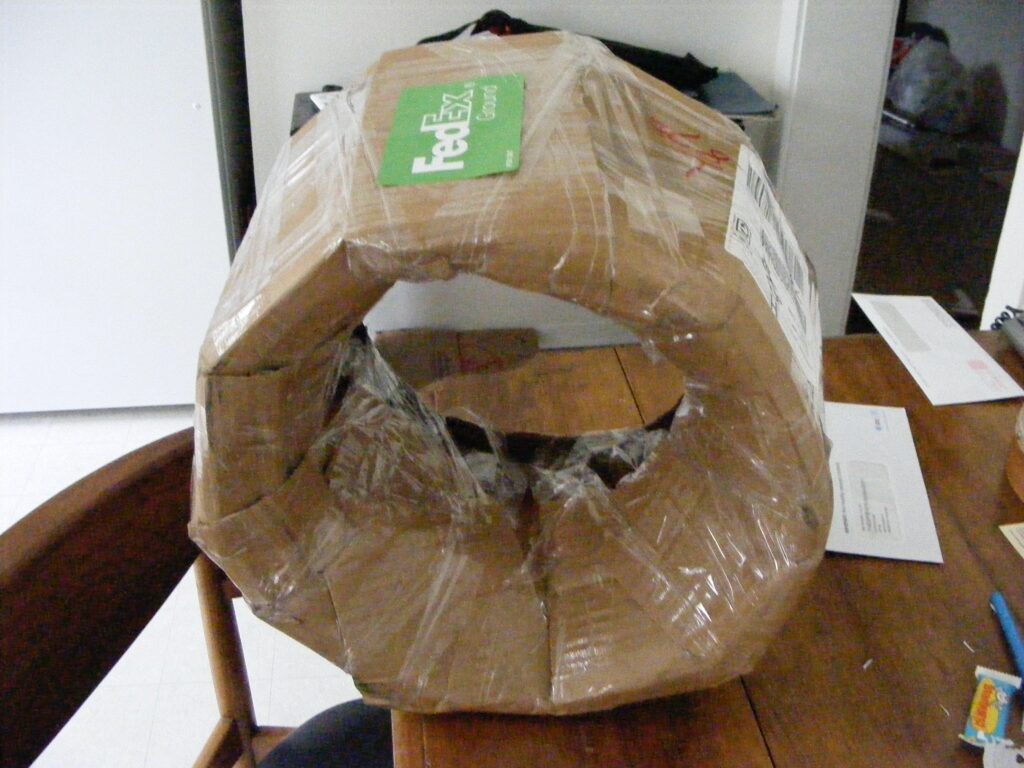
The drum shell arrived strangely packed, but it was in good shape. I shaved down the bearing edge until it was flat and level. The top sound board was attached to this. I made cutouts in the sound board for the larger nails. The smaller nails went directly into the board.
I tested the practical pitch range of each size of nail in a piece of scrap wood, getting a full range of about 3.5 octaves. I drilled 42 pilot holes in the shell and carefully hammered each nail into place, a shorter nail resulting in a higher pitch. I reinforced the shell with some machine screws to prevent splitting. The nail heads are painted for quick identification of pitches. Red is C and blue is F, borrowing from harp string conventions. A is yellow, other naturals are white, and accidentals are black.
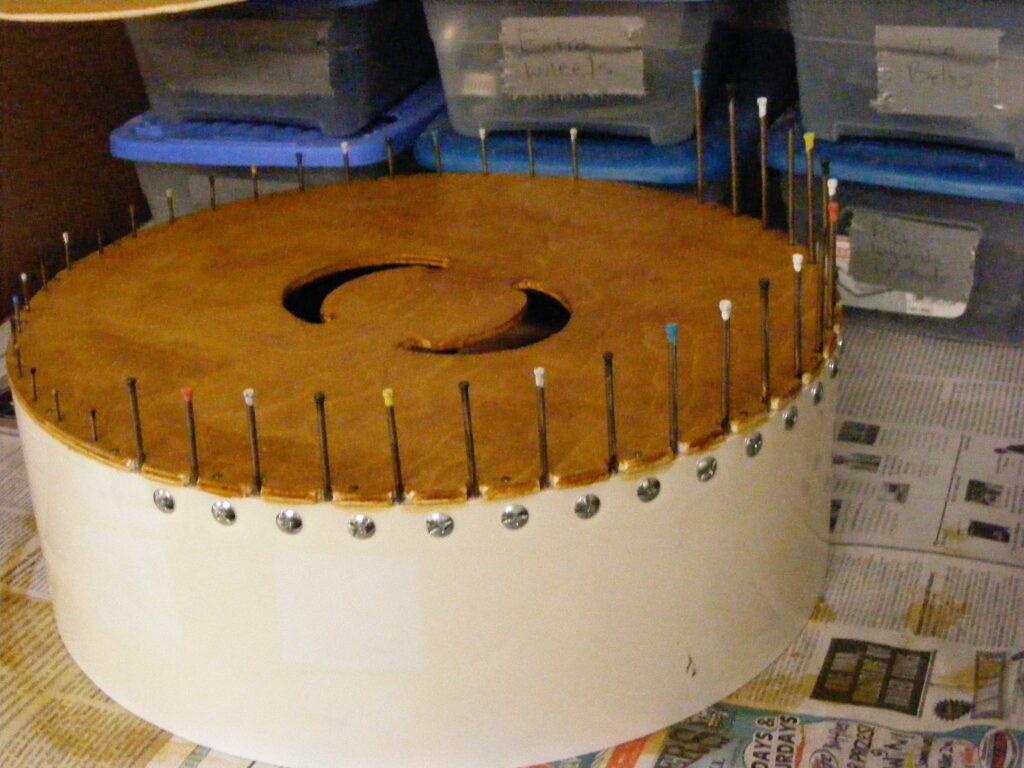
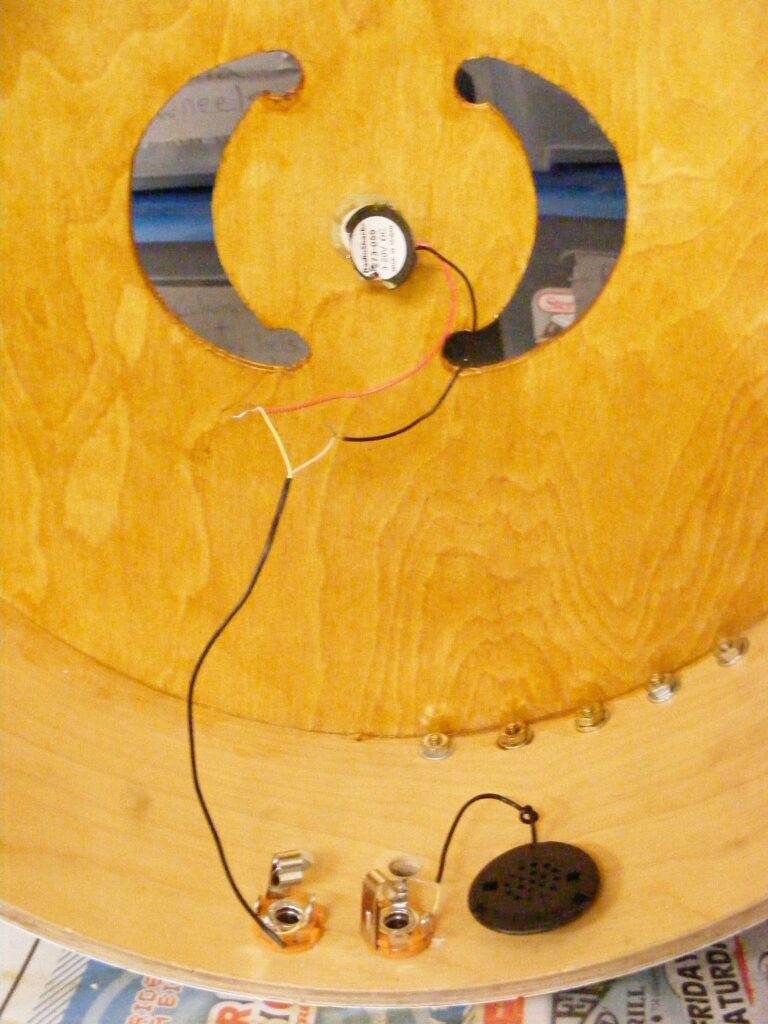
I installed two microphones: a piezo pickup and a cheap mic from some source I don’t remember – maybe a phone receiver or a little speaker wired in reverse. These were soldered to some 7mm jacks. I attached the top and bottom and painted it with shellac and acrylic paint.
The tone is distinctive and pure, but breathy and somewhat raspy. The projection is awful. At its loudest, the instrument can’t be heard over a normal volume conversation. Driving the nails directly into the shell where it meets the sound board, the stiffest part of the body, meant that the vibrations of the nails didn’t resonate much through the body. Sixteen years later, I can find descriptions online of other historic and modern developments of the concept, and the rods are always attached at least a few inches from the edge of the sound board. But at the time, I couldn’t think of a way to achieve that without the nails quickly coming loose. The pickups make it possible to amplify the instrument, but without a preamp, it takes turning the amp way up just to get a moderate volume.
The arrangement of the nails makes things challenging for the player. With 42 nails arranged in a circle, it only takes a tiny change in bow angle to hit the wrong note. If the bow gets too close to the sound board, it sounds two octaves and a fifth higher. If the bow gets too high, the hair gets tangled in the nail heads. The high notes especially are very sensitive to damage and tuning issues.
This isn’t an instrument I break out too often, but it sounds unlike any other instrument. I’m happy to have it.